7 November 2026
Build or buy? The question every operator will face (and why its terrifying tech companies)
Better code from voice, more confident operators and the need for connected systems will push operators to build their own tools. The judgement is knowing what to build and what you must still buy.
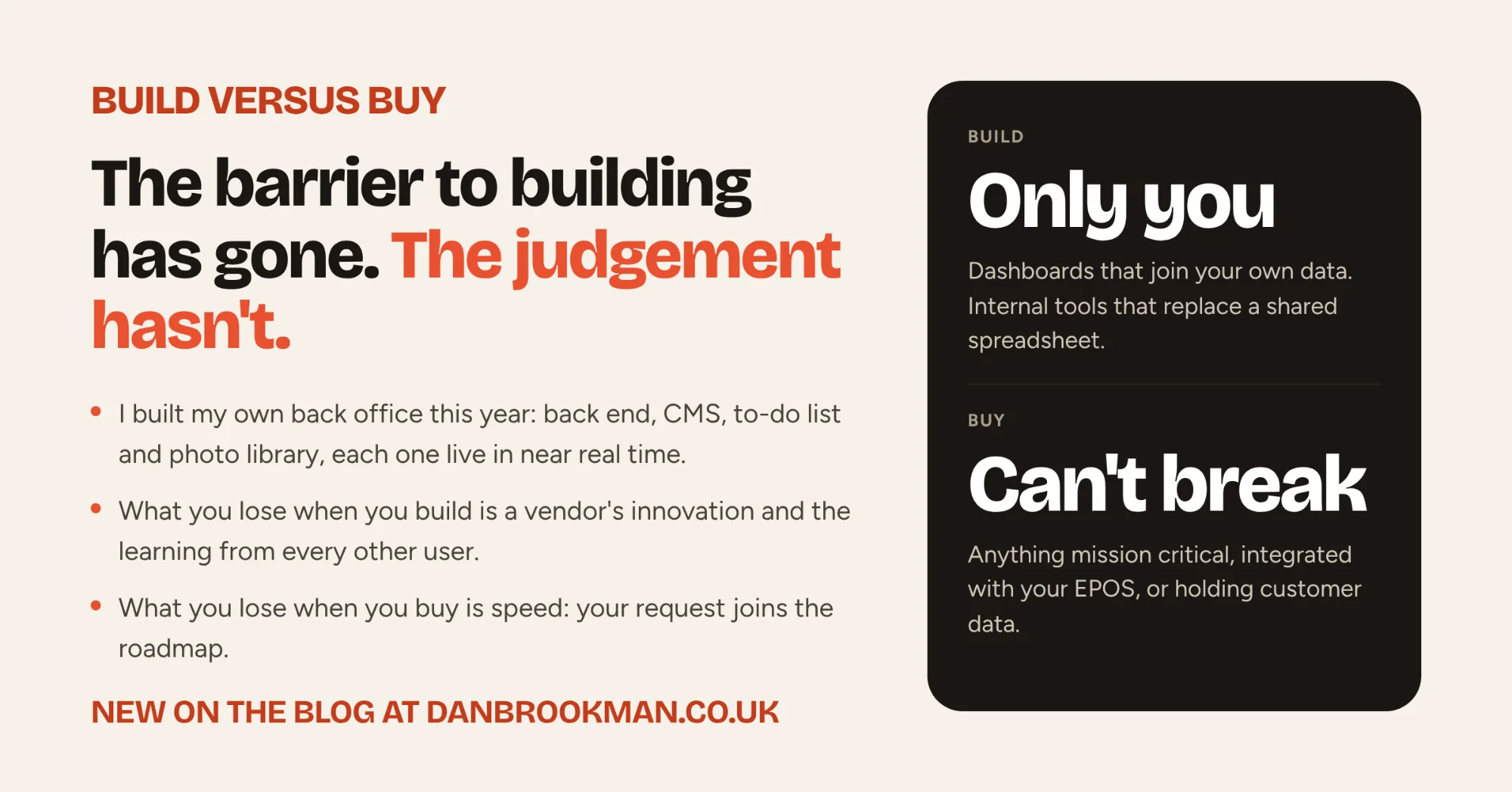
I’ve built my own back office this year. Not because I planned to, but because I could.
It started with a back end for my Claude coaching business. Then I thought a content management system would be handy, so I added one. Then a to-do list, because the volume of Claude chats open at any one time was making me lose my mind a little. Then a photo library. Every one of those changes went in pretty much in real time, and then it was there. The barrier that normally makes you stop your best work had gone. I could just go, and go, and go.
Here’s the arithmetic that convinced me. In October I spent 50.2 hours working with Claude. Claude’s own estimate of what that produced was around 1,000 hours of team output, about £57k of staff cost, for a £257 in subscriptions. Treat the big numbers as an estimate rather than payroll, but I know what I’ve built and its a substantial.
The thing is, I’m the only user. I don’t expect my Claude coaching business to employ people, not right now anyway. If it does, I’ll build a user management piece, and roles and permissions, when I need them, and that will introduce a new level of complexity, robustness and security.
That experience is the one that is going to drive build versus buy for operators over the next couple of years. Three things are moving at once. The LLMs are getting far better at writing code from a voice description. Operators are gaining the confidence to build with them and the context required for AI to do a great job. And operators need connected systems more than they ever have. Put those together and a lot of operators are going to build for themselves.
I should declare an interest. I’ve spent most of my career selling software to operators, so I have a stake in this argument. You can decide for yourself how much weight to give it.
What you lose when you build. Innovation. A company building a specific product for a specific task is 100 per cent focused on that product and 100 per cent focused on keeping it ahead in its market. They also have the learning from every other user on the platform, and that learning drives the product forward. On your own, you have one user instance.
What you lose when you buy. Speed. If you want something doing, it goes into a roadmap, to be done at a later date, when enough other people have asked for it too. I’ve sat on the vendor side of that conversation more times than I’d like.
I think that wait should shrink in the coming months and years. Tech companies are starting to use agents themselves. A feed from the customer service tool populates a specification, passes it back to the customer for feedback at scale, and the spec ends up very accurate for the problem the customer wants solved. The feature can be built almost overnight, go to a QA agent, then to a final human check before release. The release itself is another human check. That is a very different proposition from the way that we’ve worked previously.
Where I wouldn’t build. Integrations, robustness and security. If a platform is mission critical, and it integrates with one, two, three or four other pieces of your stack, you probably don’t want to build that yourself. You’re not going to build something that talks to your EPOS, because if the EPOS updates its APIs or rolls out a new version, you’ve got a problem on a Friday night. The same goes for anything holding PII. If it isn’t robust and secure, you’ve got another problem, and potentially a worse one.
Where I wouldn’t build Expertise, if you are reliant on the vendor to provide ongoing expertise as part of their service. I think that the ’relationship’ aspect of SaaS will actually grow in the future, especially if pricing is going to raise. Expertise and strategy around technology will provide added value to help operators do more.
Where I think operators will build. Two places. First, dashboards. We’ve said the dashboard is dead, and I think that’s 100 per cent the case: operators will connect lots of different data sources and run their own analysis rather than buy a tool. Second, internal systems. Anywhere a business is currently distributing a spreadsheet to multiple people is a candidate. Claude is rolling out its own spreadsheets function shortly, which feeds into artifacts, and that will let people work properly with spreadsheets inside Claude. I think that is the next change worth watching.
So the question isn’t build or buy. It’s which. Build the things only you need, that only you use, and that break nothing but your own afternoon. Buy the things that are mission critical, deeply integrated or holding customer data.
The barrier to building has gone. The judgement hasn’t. If you want to talk through where that line sits in your business, give me a shout.